





Custom Skateboard Factory in China: Choosing Trucks, Wheels and Bearings for OEM Skateboards
Related Posts
OEM Skateboard Manufacturing: Cost Factors Behind Bulk Skateboard Orders
October 29, 2026
How to Find a Skateboard Manufacturer: A Factory Evaluation Guide
October 29, 2026
Skateboard Deck Factory in China: How Pressing Shapes Deck Consistency
October 29, 2026
Custom Blank Skateboard Deck Manufacturer: Canadian Maple vs. Birch vs. Bamboo Decks
October 29, 2026
Not all skateboards turn properly. Even if something looks correct, it can have many issues such as wheels touching the deck, bind in the bearings, or the trucks not steering correctly. Often, this is due to having an incorrect or poor-fitting set of parts.
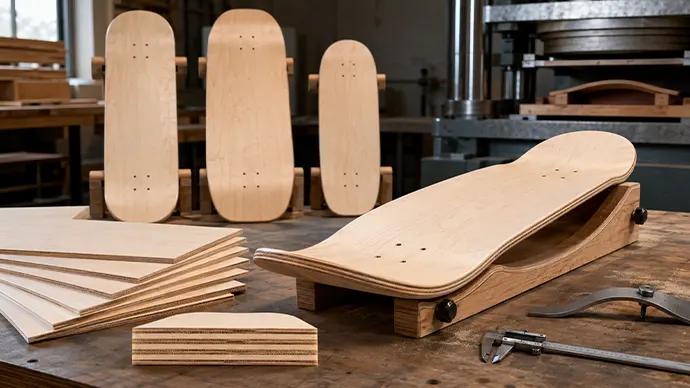
At Vigor Tech, we evaluate components as part of a complete setup. Before prototype development, the project should define the intended riding application, rider weight range, component specifications, dimensional tolerances, and target cost.
1. Start with Component Compatibility, Not Bearing Grade
Truck dimensions, wheel geometry, and bearing fit interact. Upgrades can create assembly problems.
| Component | Specification to Confirm | Main Consequence |
| Trucks | Axle/hanger width, height, bushing hardness | Support, steering, wheel clearance |
| Wheels | Diameter, durometer, contact patch, core | Obstacle rollover, grip, vibration |
| Bearings | 608 fit, shields, lubricant, material | Rolling resistance, contamination tolerance |
| Hardware | Riser thickness, bolt length, spacers | Secure assembly and wheel movement |
For OEM orders, specifications should identify actual dimensions and materials—not only catalog labels such as "high truck" or "ABEC-7."
2. Truck Selection: Width, Geometry and Construction
Match Axle Width to Deck Width
For conventional street setups, overall axle width should approximate deck width. Hanger width is not axle width; verify wheel offset and assembled track width.
Truck height is equally important. Low, mid, and high are manufacturer-specific categories, not universal millimeter standards. Increased height generally provides more wheel clearance, but also changes the rider's leverage and deck height.
Also verify:
•Bushings: Heavier riders generally need firmer bushings for comparable support. The appropriate setup also depends on truck geometry, bushing shape and height, urethane formulation, preload, and the desired steering response.
•Pivot/kingpin geo: Steering progression and the maximum lean angle are determined by this geometry.
•The strength of the component should be determined by a material test of the alloy used in the part. Forging and casting are not indicators of strength.
A Custom Skateboard Factory in China should check the geometry of the trucks, after assembly, to verify it is within the specifications they want, not rely on nominal sizes.
3. Wheel Selection: Diameter, Hardness and Urethane Behavior
Wheel behavior depends on both urethane formulation and geometry, not durometer alone. Smaller, harder wheels are common in conventional street and park setups, while larger, softer wheels are often selected for cruising on rougher surfaces. Increasing wheel diameter reduces deck clearance unless the setup is adjusted.
| Wheel Specification | Common Starting Application | Trade-off |
| 52–54 mm; around 99A | Street/park on smoother ground | Quick response; more vibration on rough pavement |
| 56–60 mm; 78A–87A | Casual cruising | Better shock absorption; clearance must be checked |
| 60–70 mm; softer compounds | Surfskate/carving | Grip and rollover; greater wheelbite exposure |
These are starting ranges, not product guarantees. Hardness claims above the Shore A scale require test-method clarification.
Beyond Durometer
PU compound, rebound, contact-patch width, lip profile, and core placement all influence grip and rolling losses. Two wheels labeled 85A can behave differently on rough asphalt.
Our configurable wheel options include HR and SHR polyurethane, graphics, and hardness choices. For a Custom Skateboard Factory in China, the useful comparison is a controlled sample ride using the same deck, trucks, surface, and rider load.
4. Bearings: Fit and Sealing Matter More Than ABEC Marketing
Standard skateboard wheels typically use 608 bearings (8 mm bore × 22 mm outer diameter × 7 mm width), normally two per wheel. Check axle diameter, wheel-core seats, spacer length, and washer placement; incorrect axial loading can make a new bearing feel rough.
ABEC grades describe certain dimensional tolerances. They do not rate impact resistance, sealing, lubrication, or real-world skateboard speed.
| Bearing Choice | Purchasing Consideration |
| Carbon/chrome steel | Compare heat treatment, corrosion resistance, and consistency |
| Higher ABEC grade | Verify the claimed standard; do not assume faster riding |
| Ceramic option | Confirm whether hybrid or full ceramic and justify additional cost |
| Contact seals vs shields | Balance dirt exclusion, rolling drag, and serviceability |
Vigor Tech lists steel and ceramic bearing options. We prioritize fit, lubrication, seals, and repeatable rolling tests.
5. Match the Complete Setup to Its Intended Use
| Product Program | Configuration Priority | Main Verification |
| Street | Deck-matched trucks; compact, harder wheels | Turning response and trick clearance |
| Beginner complete | Predictable steering; moderate wheel setup | Rider-load stability and hardware security |
| Cruiser | Softer, larger wheels; compatible risers | Rough-surface ride and wheelbite |
| Surfskate | Purpose-designed front truck; grippy wheels | Lean clearance and steering travel |
| Longboard | Application-specific truck geometry and wheel size | Stability, grip, and loaded clearance |
Wheelbite is an assembly-level risk: wheel radius, truck height, bushing compression, deck contour, and rider load interact. Check maximum practical lean under load, then adjust wheel size, bushing setup, riser thickness, or truck geometry. Any riser change also requires a fresh check of mounting-bolt length and thread engagement.
6. From Prototype to Full-Scale Production
While a first time customer of a skateboard manufacturer typically will not request a sampling bill of materials (BOM), it is a good practice for customers to provide a component BOM along with measurable acceptance criteria.
Some examples of acceptance criteria could be the following:
•Dimensionally – the width of a deck and axles, the diameter of the wheels, bearing seats, truck drilling, fit of hardware.
•Functionally – Turn initiation clearance and free wheel clearance, free wheel rotation, side play, noise, and fastener tightness.
•Material – Hardness of wheels, type of bearing and seal, and truck alloy.
•Production Control – An approved sample, and traceability of component lots. Specify the frequency of inspection and provide a basis for accepting deviations.
EN 13613:2009 identifies safety and functional requirements of non-motorized, complete skateboards and excludes skateboards intended to be used by persons under 20 kg. Other requirements may apply, depending on the destination of the product and product category.
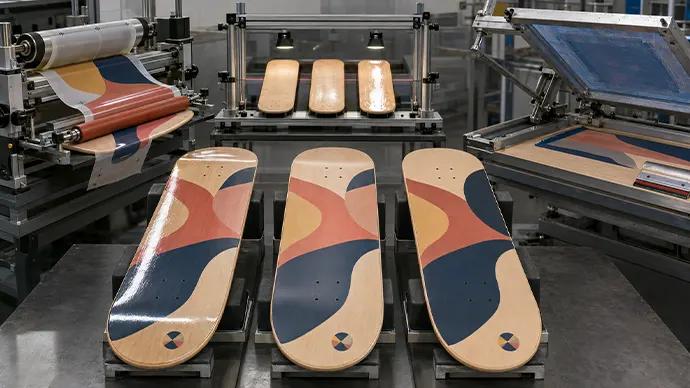
At Vigor Tech, we support deck construction, branded trucks, PU wheels, bearings, graphics, packaging, and sample-to-bulk coordination. The quotation should reflect the confirmed component specification, intended market, order volume, and inspection requirements—not an unsupported promise that one premium part makes the whole board better.
For a private-label complete skateboard, send us your deck dimensions, riding application, target price, and preferred components. Explore Vigor Tech's OEM/ODM options to discuss your specifications.
FAQs
Q1. Can Vigor Tech manufacture complete OEM skateboards?
Yes. We provide OEM/ODM skateboard manufacturing, including custom decks, trucks, PU wheels, bearings, grip tape, and branded packaging.
Q2. Can Vigor Tech customize skateboard trucks?
Yes. We offer custom truck colors and engraved logos. Truck specifications can be selected according to deck dimensions and riding requirements.
Q3. What skateboard wheel options does Vigor Tech offer?
We offer HR and SHR polyurethane wheels with different hardness options, sizes, and custom graphics for various skateboard applications.
Q4. What bearing types are available from Vigor Tech?
We offer carbon steel and chrome steel bearings in ABEC-3, ABEC-5, ABEC-7, and ABEC-9 options, along with ceramic bearing options.
Q5. How does Vigor Tech match trucks and wheels for OEM skateboards?
We consider deck width, truck geometry, wheel diameter, hardness, riding style, and clearance requirements when discussing component configurations.


In This Article
- 1. Start with Component Compatibility, Not Bearing Grade
- 2. Truck Selection: Width, Geometry and Construction
- 3. Wheel Selection: Diameter, Hardness and Urethane Behavior
- 4. Bearings: Fit and Sealing Matter More Than ABEC Marketing
- 5. Match the Complete Setup to Its Intended Use
- 6. From Prototype to Full-Scale Production
Show All
Collapse
Related Posts
OEM Skateboard Manufacturing: Cost Factors Behind Bulk Skateboard Orders
October 29, 2026
How to Find a Skateboard Manufacturer: A Factory Evaluation Guide
October 29, 2026
Skateboard Deck Factory in China: How Pressing Shapes Deck Consistency
October 29, 2026
Custom Blank Skateboard Deck Manufacturer: Canadian Maple vs. Birch vs. Bamboo Decks
October 29, 2026
Start Your Project
-

Custom skateboard solutions from deck design, materials, graphics to complete product development.
-
Professional OEM support covering sampling, production, quality control and bulk delivery.
-
Provide reliable production support for brands, distributors and retailers worldwide.


