





Custom Printed Skateboard in Bulk Decks: Heat Transfer vs. Screen Print Quality
Related Posts
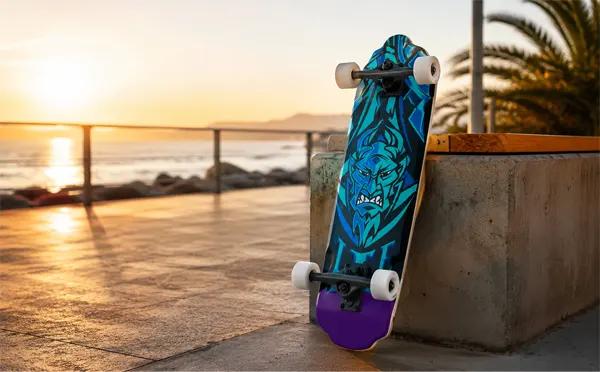
OEM Skateboard Manufacturing: Cost Factors Behind Bulk Skateboard Orders
October 29, 2026
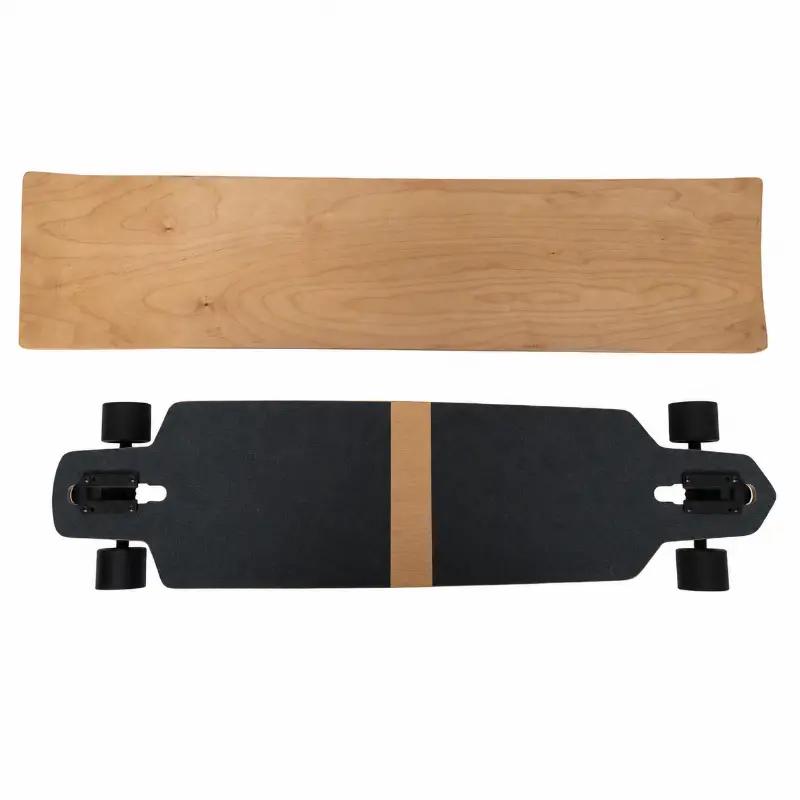
How to Find a Skateboard Manufacturer: A Factory Evaluation Guide
October 29, 2026
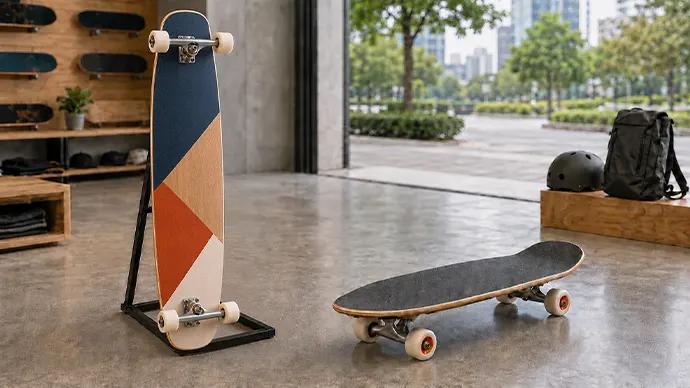
Skateboard Deck Factory in China: How Pressing Shapes Deck Consistency
October 29, 2026
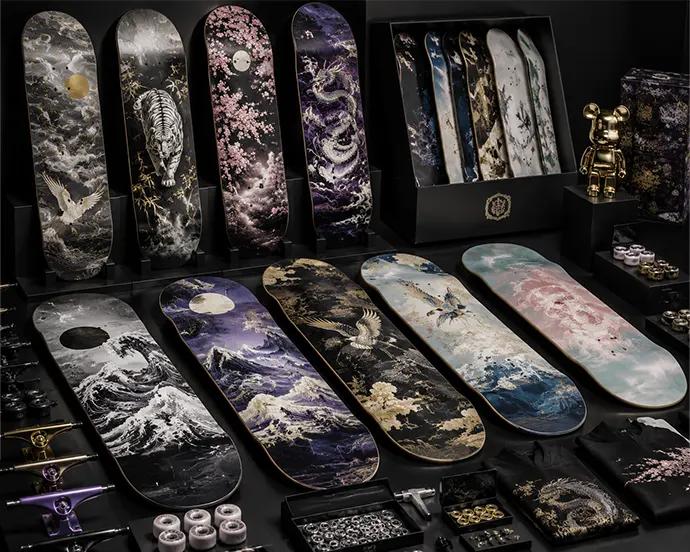
Custom Blank Skateboard Deck Manufacturer: Canadian Maple vs. Birch vs. Bamboo Decks
October 29, 2026
For custom printed skateboard decks, graphic quality depends on more than artwork resolution. Surface preparation, ink or transfer compatibility, adhesion, color accuracy, finishing, and production consistency all affect the result. These factors also influence unit cost and rejection rates in bulk production.
Heat transfers are good for producing skateboard deck graphics in a full color or photo realistic fashion at an affordable cost. Screen printing, however, can be less costly for designs with limited color pallets, and usually requires less pages for set up. The cost of producing a skateboard deck at Vigor Tech is determined by a number of factors including number of colors in an illustration, what kind of finishing coat, if any, is used on the deck, the materials of the deck, and the size of the order.
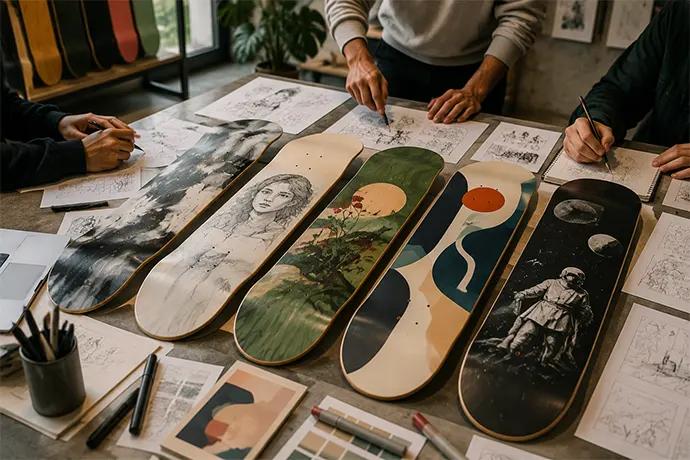
1. Heat Transfer Printing and Screen Printing
Heat Transfer Printing
When using the heat transfer printing method, an image or design is printed out on paper and then pressed onto the deck. Because of this method, illustrations and photos can be printed in a skateboard deck in a full color and realistic fashion. This method can also be used to create skateboard decks with gradients. There are, however, a few constraints with this method:
•Temperature and Dwell Time: All affect release, bond and coating system compatability.
•Adhesion is dependent upon how the substrate was prepared and pre-existing coatings.
•Deck Geometry and Shape: Concave decks and other contoured shapes can cause distortion, and anomolies in transfers.
Tight registration is essential in screen printing to achieve good image quality. The properties of the screen (tension, mesh size) and stencil (material, thickness) can effect the image. So can the viscosity of the ink, the speed and pressure of the squeegee, and the environmental conditions.
Gradient fills and transparencies can vary in difficulty based on the color scheme. For screen printed skateboard decks, setup time is driven by the art, and the complexity of the colors and shapes. This can effect production time and costs for large orders.
2. Heat Transfer vs. Screen Printing: Performance Comparison
The final outcome of a printing process is the result of many factors including the adhesion of the transfer/ink to the surface, the cohesion of the interlayer, curing and protective finishing.
Neither process makes a transfer more resistant to scratching.
| Performance Factor | Heat Transfer | Screen Printing |
| Graphic Resolution | Suitable for detailed artwork (within limits) | Limited by screen and stencil definition |
| Gradient Reproduction | Generally more suitable | Requires specialized separation |
| Ink/Graphic Adhesion | Depends on transfer compatibility | Depends on ink/substrate bonding |
| Abrasion Resistance | Depends on transfer and coating conditions | Depends on ink and coating conditions |
| Color Registration | Accurate positioning of the transfer | Multiple alignment of the screens |
| Surface Finish | Requires compatible finish | Requires compatible finish |
| Large Repeat Orders | Depends on art and set-up | Often more economic for simple art |
Why Do Printed Graphics Peel, Fade or Scratch?
Problems with printed graphics is more commonly seen during the production process rather than the printing process.
•Peeling: This occurs when the graphic is not sticking to the board due to poor adhesion.
•Abrasion: This occurs when the graphic coating is removed during production or from a lack of finishing.
•Color variation: Due to differences in the curing process and non- uniform chemical composition of the ink.
•Misregistration: Misregistration occurs when the alignment of colors is not correct with respect to the registration marks.
•Fading: Environmental conditions causes the printed graphic to fade over time.
At Vigor Tech we do surface preparations and finishes. Transparent finishes let the wood grain show through and opaque finishes can cover the wood grain.
3. What Determines Bulk Printing Costs and Production Consistency?
Fixed costs are associated with setup and variable costs are associated with production. A more realistic approach to costing would be to charge a fixed set up cost and absorb the costs of printing, finishing and inspection as well as anticipate rejections.
| Cost Factor | Heat Transfer | Screen Printing |
| Initial Setup | Transfer preparation | Screen preparation |
| Multiple Colors | Depends on the design | Additional screens are required |
| Design Changes | Depends on the transfer preparation | Screen changes are required |
| High-Volume Repeats | Transfer cost per deck | Fixed setup cost is spread over more units |
| Production Waste | Transfer defects and finishes that are rejected | Registration and printing defects |
Considerations for bulk orders:
•MOQs are specific to designs and are not the same as total order quantities.
•Multiple SKUs may require the production of multiple designs, resulting in multiple changeovers.
•Lead time includes time for artwork approval, sampling, production scheduling, finishing, inspection and packing.
Repeat orders should use version-controlled artwork and agreed color references. Any changes should be reviewed and approved before production.
Price and delivery time are defined with a confirmed order. (Pricing and lead time are confirmed during quotation based on the agreed specifications, artwork, quantity, and production requirements.
4. How Should Buyers Verify Printing Quality?
The printing quality for production can be verified with a sample. However, batch inspection can be done to check if the subsequent decks are printed as per the sample specification.
Prior to production of Custom Printed Skateboard Decks Bulk, it is necessary to have measurable acceptance criteria.
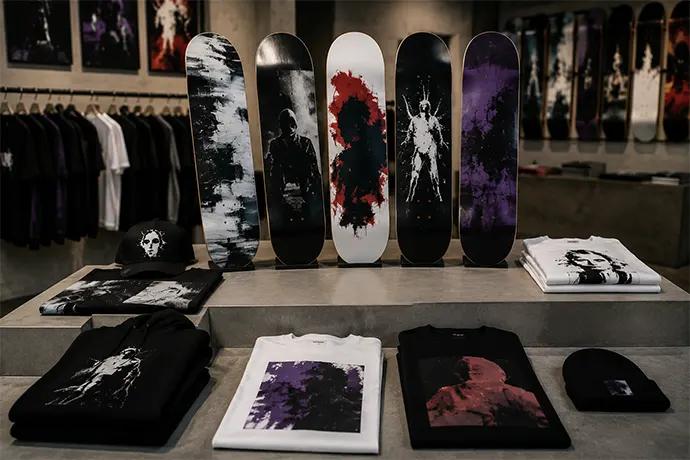
Key Inspection Checkpoints:
Pre-Production Approval
•Check AI/PDF artwork for resolution and bleed
•Accept Pantone references or physical color standards
•Check deck size and concave
•Check wood material, surface finish and requests (colors, lettering)
In-process Inspection
•Inspect registration of graphics at nose and tail
•Check for transfer defects (jitter, pinholes, etc.)
•Compare production samples to master sample
Final quality verification
| Verification Method | Inspection Purpose |
| ISO 2409 | Cross-cut coating separation assessment where applicable |
| ASTM D5264 | Comparative rub-abrasion evaluation of suitable printed specimens |
| ASTM D2244 | Instrumental color-difference calculations |
| Visual Inspection | Scratches, peeling, registration, and finish defects |
| Packaging Inspection | Protection against handling and transportation damage |
These standards can serve as a guide for possible tests for the certification of finished skateboard decks, but do not automatically provide certification.
Color measurements should use the same geometry and surface condition as references since gloss can create apparent color differences.
5. What Printing Method Fits Different Skateboard Orders?
The optimal process is dependent on the graphic requirements, positioning of the product in the marketplace, and overall economics of making the product.
| Application | Preferred Approach | Main Consideration |
| Full-color artistic decks | Heat transfer | Detail, gradients, and thickness |
| Bulk logo skateboards | Screen printing | Artwork |
| Limited-edition collections | Heat transfer or UV printing | Thickness |
| Promotional decks | Heat transfer or screen printing | Thickness and quantity |
| Retail riding decks | Application-dependent | Coating and durability, and construction of the deck |
Printing quality is also separately evaluated with respect to how a deck bends and its ‘pop’. Graphic printing is the main factor for surface durability and overall appearance.
For example, 7-ply Canadian maple construction and cold pressing gives a deck its stiffness, pop, and dimensional stability.
Buyers should evaluate these specifications together. Consideration of premium artwork as evidence of superior deck construction is misplaced.
6. Skateboard Deck Bulk Manufacturing at Vigor Tech
At Vigor Tech, some of the bulk manufacturing options include heat transfer, silk screen, and UV digital printing. We also provide OEM/ODM deck customization services.
We provide 7-ply Canadian maple, and other wood constructions, different concave profiles, and matte/glossy finishes.
To assess production feasibility and prepare a quotation, please provide:
• Artwork files, target colors, and any physical color references.
•Specifications of deck construction, dimensions and concave.
•Order quantity and variations.
•Finishing and packaging requirements.
•Target market and delivery schedule.
•Anticipated Graphics and design complexity should drive the choice of an approved printing process.
Vigor Tech has the deck specifications, OEM/ODM Manufacturing and printing process to meet your skateboard bulk requirements. Share your design and bulk order requirements with us.
FAQs
Q1: What printing methods does Vigor Tech offer for custom skateboard decks?
We offer heat transfer printing, silk screen printing, and UV digital printing for different artwork and production requirements.
Q2: Which printing method does Vigor Tech recommend for complex graphics?
We generally recommend heat transfer printing for detailed illustrations, multicolor graphics, and color gradients.
Q3: Is screen printing suitable for bulk skateboard orders?
Yes. We offer screen printing for repeated logos and limited-color designs, particularly in larger production quantities.
Q4: What skateboard deck materials does Vigor Tech provide?
We offer 7-ply Canadian maple, maple-birch hybrid, bamboo, and other deck material options based on project specifications.
Q5: Can Vigor Tech customize skateboard surface finishes?
Yes. We provide matte and glossy finishes to accommodate different graphic appearances and product requirements.


In This Article
- 1. Heat Transfer Printing and Screen Printing
- 2. Heat Transfer vs. Screen Printing: Performance Comparison
- 3. What Determines Bulk Printing Costs and Production Consistency?
- 4. How Should Buyers Verify Printing Quality?
- 5. What Printing Method Fits Different Skateboard Orders?
- 6. Skateboard Deck Bulk Manufacturing at Vigor Tech
Show All
Collapse
Related Posts
OEM Skateboard Manufacturing: Cost Factors Behind Bulk Skateboard Orders
October 29, 2026
How to Find a Skateboard Manufacturer: A Factory Evaluation Guide
October 29, 2026
Skateboard Deck Factory in China: How Pressing Shapes Deck Consistency
October 29, 2026
Custom Blank Skateboard Deck Manufacturer: Canadian Maple vs. Birch vs. Bamboo Decks
October 29, 2026
Start Your Project
-

Custom skateboard solutions from deck design, materials, graphics to complete product development.
-
Professional OEM support covering sampling, production, quality control and bulk delivery.
-
Provide reliable production support for brands, distributors and retailers worldwide.


