





Canadian Maple for Skateboards: What Makes It So Special?

Related Posts

Canadian Maple for Skateboards: What Makes It So Special?
November 12, 2026

Skateboard Wholesale Supplier: Build a Better Supply Chain
November 12, 2026

Skateboard Manufacturer for Skate Brand | Custom & Wholesale
November 12, 2026

Skateboard Deck Sizes Explained: A Beginner’s Guide
November 12, 2026
Why is Canadian Maple Used for Skateboards?
Canadian Maple Is Hard Maple
Acer saccharum, commonly known as hard maple, rock maple, and Canadian maple. Hard maple is the only wood known that can withstand the punishment delivered by the modern skateboarder. According to the US Department of Forestry, the hard maple grows from Nova Scotia westward to Ontario, southward into Texas, east into Georgia, and up the Appalachian Mountains into New England. But the trees we care about are here in the Great Lakes region of North America. All the wood for a pro-level skateboard comes out of the Great Lakes region, period.
Canadian Maple Properties for Skateboard Decks
Hard maple has a lot of properties that are very important to the skateboard industry. Its elasticity, its density, its shock-absorbing properties. What gives it those properties are the regions in which it grows. If you take some hard maple tree and put it somewhere else, it doesn't mean you can't get it to grow. It just won't grow in the manner that's going to make it good for making a skateboard.
How We Build Our Maple Decks
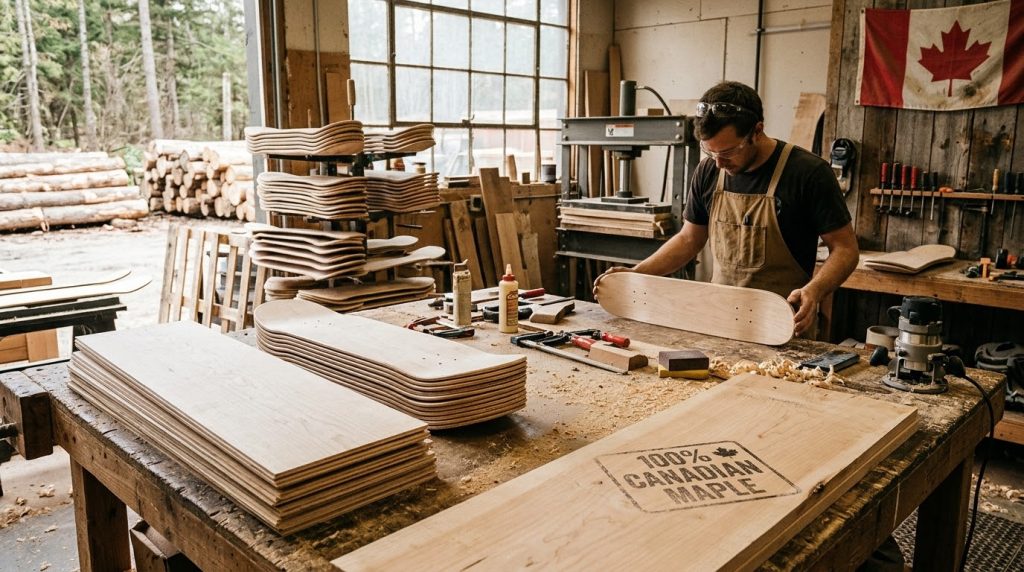
All of our decks use 7-ply maple. Some, like our 29” × 7.25” Complete and our 32” × 10” Dual Motor Electric Skateboard, use 7-ply Northeast maple. This is hard maple chosen for the same reasons skaters love: strength, pop, and lasting shape.
We check the wood before use. We dry it, layer it, glue it, and press it with care. We also keep thickness steady. Our 29” × 7.25” deck is 10.5 mm thick. Our 31” × 10” and 32” × 10” surfskate decks are 10 mm thick.
Maple Boards in Our Range
• 29” × 7.25” Complete Maple Skateboard: A compact street board with 5-inch trucks, 53 × 31 mm wheels, and a dye laser-engraved logo.
• 31” × 10” Surfskate Complete: A compact surfskate with 6-inch 180 trucks and 65 × 51 mm wheels.
• 32” × 10” Maple Surfskate Complete: A wide surfskate with 6.5-inch turning trucks for carving.
• 32” × 10” Dual Motor Electric Skateboard: An electric board with a dual motor drive and an 18650 battery pack.
Why Cold Winters Make Maple Strong
With temperatures ranging from 40 degrees below zero to a hundred degrees above, and a relatively short growing season, hard maple soaks up water from humidity and shoots up while freezing intensifies it during the winter. This is the magic combination that makes hard maple the perfect material for skateboards. Dense wood is strong wood. Hard maple is stiff, but it can still bend a little, and that spring is the pop of a good deck.
Maple Has Become the Standard for Skateboards
This maple has become a standard of skateboarding. People have tried to reinforce it with other raw materials to make it stronger. But the characteristic of maple, and how it grows and expands, has never been duplicated or made better by other raw materials. That's why it matters today.
In the 1970s, manufacturers would experiment with laminated maple veneer decks. This was the formula that would prove to be the ultimate combination of strength, flexibility, and low weight.
How Tough is Maple Under Impact Force
The hard maple is such a dense tree that these 12-foot sections of logs weigh in at nearly one ton. But how tough is the maple, and better yet, how much force can a skateboard take? To figure this out, we came to Sole Technology, makers of etnies, at the Sole Technology Institute. STI is a scientific research lab solely dedicated to the study of action sports.
This is the force plate. It tells us not only how much vertical force is being applied, but we're also getting three-dimensional moments. So we can measure how much twisting force or torque he's coming down on the plate with. This is Ryan Sheckler, and Ryan weighs in at 114 pounds.
What we found today is that when Ryan was skating a handrail and landing tricks, he was averaging about six to twelve and a half times body weight. Ryan's heaviest landing of the day was around twelve and a half times his body weight. So let's do the math. Sheckler weighed in at 114 pounds and on his heaviest landing came down with the force of 1425 pounds.
The largest impact force we've ever recorded here in the lab was from an individual who weighed 180 pounds. He came down on the force plate with 22 times his body weight, which is roughly equivalent to about 4,000 pounds of force.
Maple Tree Age and Veneer Grade
The maple you harvest is generally between 40 and 80 years old. They can be as old as 100 to 120 years old. Much beyond that, you've exceeded the useful life of a maple tree. In an 80-foot tree, only the bottom 20 feet or so are actually veneer grade, because it has the fewest branches in it. The rest of the tree ends up becoming lumber for furniture. Hard maple is a material that has a high tensile strength. It's not like what you would find in a two-by-four. It's a very hard, tough wood. You look at a skateboard when it smacks into a curb, and it takes a lot of abuse.
From Maple Logs to Skateboard Veneer
Back in the forest, the veneer-quality logs are being tagged and sent off to the mill, where their journey into becoming a skateboard truly begins. Trees are perishable, if you will. They can't stay on the shelf forever. Once cut down, they have a limited lifespan before they can be processed into good veneer. The rule is that most trees are harvested and then processed by our plant within eight to ten weeks from the date of cut.
First, the logs are cooked in large water vats at a temperature of 150 to 180 degrees Fahrenheit. Logs are then sent into the mill, pre-marked and cut for skateboards. A 34- to 35-inch cutting will bring in ten-foot logs, and we'll take three blocks out of that log. Set against a blade, the logs are spun down, creating a ribbon of veneer. Within minutes, the logs become hundreds of feet of material.
Sustainable Maple Forestry
Taking this tree, which is obviously healthy and robust, and leaving something like that, one that's had a major injury, we're short-sticking the landowner and the stand. We're taking quality genetics and leaving garbage. That's our goal: not to do that. We're going to come and try to relieve the stress, so that if we do have a drought or an insect attack of some sort, the trees have the strength to repel it.
Maple Keeps Its Shape and Resists Chips
A good deck must keep its curve. Dense maple holds its shape well once it is pressed. This means the concave, the nose, and the tail stay in place for a long time. Skateboards also hit things. Softer woods chip and dent easily, but hard maple is tough on the surface and resists chips and dents better. This helps the deck look good and last longer.
Great wood is important, but it is not enough on its own. Even veneers, good drying, smart layering, even glue, and good pressing matter just as much.
Share on Social:


- PREV: Skateboard Wholesale Supplier: Build a Better Supply Chain
- NEXT: Null
In This Article
Related Posts
Canadian Maple for Skateboards: What Makes It So Special?
November 12, 2026
Skateboard Wholesale Supplier: Build a Better Supply Chain
November 12, 2026
Skateboard Manufacturer for Skate Brand | Custom & Wholesale
November 12, 2026
Skateboard Deck Sizes Explained: A Beginner’s Guide
November 12, 2026
Start Your Project
-

Custom skateboard solutions from deck design, materials, graphics to complete product development.
-
Professional OEM support covering sampling, production, quality control and bulk delivery.
-
Provide reliable production support for brands, distributors and retailers worldwide.


