





Skateboard Manufacturer for Skate Brand | Custom & Wholesale

Related Posts

Canadian Maple for Skateboards: What Makes It So Special?
November 12, 2026

Skateboard Wholesale Supplier: Build a Better Supply Chain
November 12, 2026

Skateboard Manufacturer for Skate Brand | Custom & Wholesale
November 12, 2026

Skateboard Deck Sizes Explained: A Beginner’s Guide
November 12, 2026
Partnering with a Reliable Skateboard Manufacturer for Your Skate Brand
Starting a skate brand is one thing. Growing it is another. When orders move from a few dozen boards to a few thousand, small problems become big ones. The answer is not to work harder on every order. It is to build your production on a partner who can repeat the same quality, order after order.
We are going to show you how to find the best skateboard manufacturer for your skate brand. Too many founders mess this up.
Step 1: Become the Expert in Your Own Product
Most founders mess this up before they even get started. They have a product idea, they sketch something out, they go to a manufacturer and say, “Hey, how do I make this?” That’s the wrong direction because the second you do that, you’ve put the manufacturer in charge of your product instead of you. And no skateboard manufacturer for a skate brand is going to care about your product more than you do. What you actually need to do before you reach out to any manufacturer is become the subject matter expert in your own product.
Three Things to Communicate
There are three things you need to be able to communicate before you ever contact a manufacturer. First, market understanding. What problem are you solving? Who are your customers? Who are your competitors, even the indirect ones? Second, product definition. What is your product and, just as importantly, what is it not? What materials does it use? What does it need to do? Are there any regulatory requirements? Third, you need documentation. Let’s say at a minimum you need what’s called a product requirement doc or PRD. Don’t let the name scare you.
From there, you can level up to a tech pack, which is a more visual document with measurements, materials, and specifications. And if you can sketch your product, even better, but it doesn’t have to be fancy.
You Don’t Need Every Detail Yet
You don’t need to know exactly every single material that you’ll end up using; you just need to know enough to communicate the vision. The manufacturer is the executor; the founder is the expert.
We plan every board as a complete setup. Deck, trucks, wheels, bearings, shock pads, and grip tape are matched around one approved specification. Once you sign off, that same spec carries into every repeat order.
Step 2: Research the Right Region and Partner for Skateboard Manufacturing
You see, countries and regions specialize. The supply chain, the workforce, the sub-suppliers, they cluster. Going to a region that specializes in your product gets you better quality at lower cost. Going to a region that doesn’t is fighting uphill the whole way. Not because they’re the cheapest, but because they’re the most specialized.
Trade Shows and Referrals
Meeting manufacturers in person at trade shows is one of the highest-signal ways to find a partner. If you know someone who’s already manufactured a product, ask them. This is the safest path because you’re inheriting their vetting work.
Skateboard Manufacturer or Trading Company?
You want to make sure you’re dealing with a manufacturer, not a trading company. What’s a trading company? It’s a middleman. They take your specs, find a factory to make your product, and mark up the price and pocket the difference. Sometimes they add value; often they don’t. Our recommendation for first-time creators: don’t try to vet 50 factories; pick three to five candidates from these channels. Quality over quantity.
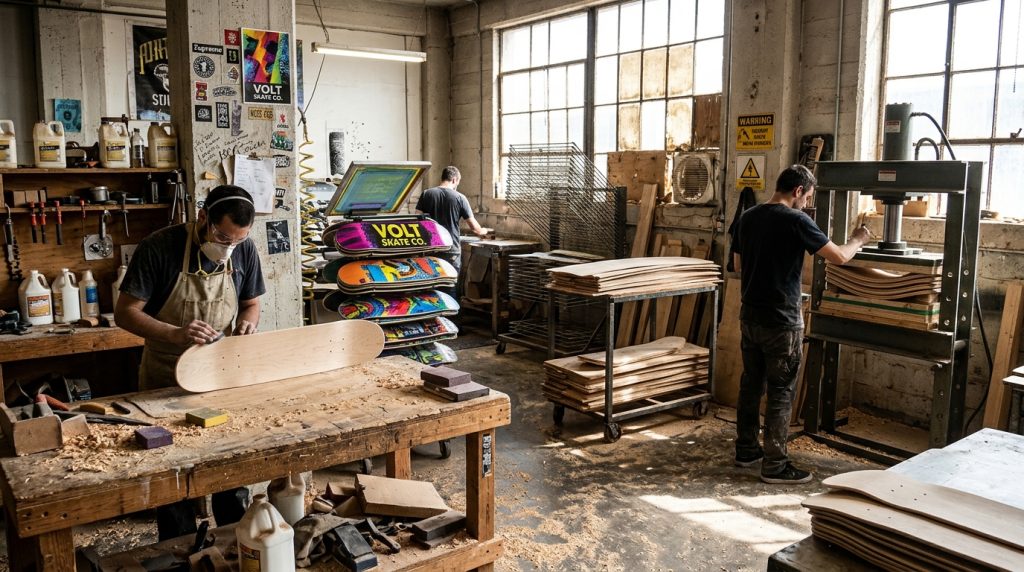
Step 3: Think About Total Cost, Not Just Unit Cost
Total cost includes unit price plus tooling plus shipping plus import duties plus tariffs plus the time you spend managing the supply chain. When you add all that up, the math gets a lot more interesting.
One Factory Vs Many Suppliers
So if your product needs seven different components, in China you talk to one factory, and they handle the whole supply chain. In the US, you might be managing seven different supplier relationships yourself, negotiating with each, coordinating timelines, chasing quality. That’s a lot of work for a founder.
Working with one manufacturer also frees your time. Instead of chasing suppliers for parts, prints, and packaging, you can focus on design, marketing, and growing your retail network.
Step 4: Vet How They Communicate
Choosing a manufacturer is like choosing a business partner because at the end of the day, that’s exactly what they are. They’re going to be a critical part of your business for years, maybe decades.
The Communication Checklist
One, are they responsive? When you email or message them, do they get back to you within a day or two? Two, do they communicate in detail? Do they give you specific answers or vague yes-no responses? Three, customizability. Can they actually make what you’re asking for? Or are they trying to push you toward what they already make? Four, lead times. Five, and this one’s underrated, prioritization. Smaller factories often value your business more than huge factories with hundreds of clients. And six, are they willing to sign an NDA? This is a quick filter for whether they take IP protection seriously.
Ask Layered Questions
So, instead of asking, “Can you do X?” ask layered questions like, “How have you done X before? Can you show me an example of X you’ve built?” If they say yes and then change the subject, that’s a yes that doesn’t mean yes.
Red Flags to Watch For
Never 100% upfront. Lack of transparency about their process or their supply chain. Good manufacturers are happy to walk you through how things work. Sketchy ones aren’t.
Step 5: Visit the Skateboard Manufacturer Factory and Get Samples
If you were entering a real business partnership with someone, let’s say splitting equity in a company, you wouldn’t sign that paperwork without ever meeting them face-to-face. You want to be in the same room, look them in the eye, get a feel for who they actually are. And picking a manufacturer is no different.
Green Flags at the Factory
One, in business for 10 or more years. Two, a bright, clean facility. The physical space tells you something about how they run their operation. Three, a real sample room with actual products in it, not just photos on a website. Real finished products you can pick up and inspect. Four, they’re prepared for you.
Always Approve a Sample First
A sample that looks great means little if bulk production does not match it. Don’t pay a single dollar for production until you’ve received a sample from the factory and you’re actually happy with the quality. This is non-negotiable. If you have the budget, an even better strategy is to have two or three factories make a sample. Comparing the samples tells you whether poor quality is coming from your product’s complexity or from a specific factory’s capability.
You see and test the board before you commit. Samples let you check the ride, the finish, and the branding. When the sample is approved, bulk production follows the same setup.
Step 6: Know What’s Negotiable
Trust is a payment history thing; you earn it. You’re going to be paying up front. That’s just how it works for new customers.
Use MOQ to Lower Unit Cost
Now, here’s where you do have leverage, and it’s actually the biggest lever first-time founders have: MOQ, or minimum order quantity. But the twist is the move isn’t to negotiate the MOQ down; it’s to negotiate the unit cost down by going up on MOQ. If you commit to a bigger order, their per-unit cost goes down, and they’ll usually pass some of those savings on to you.
Standard Payment Terms
For production, once tooling is done and you’re running parts, you’re typically looking at a 30 to 40% deposit with the order and the balance due before the product is released for shipping. If a factory demands 100% up front, run away.
Step 7: Build In Quality Control
You can pick the perfect manufacturer, negotiate the perfect deal, and still end up with a garbage product if you don’t have a quality control process built in.
Questions to Ask About QC
Here’s what you should be asking candidate factories about their QC process. One, how do they QC components coming in before assembly? Most factories don’t make every single component themselves. They buy parts from sub-suppliers. If they’re not inspecting incoming parts, you’re going to get problems. Do they do pre-shipment statistical sampling? You want a factory that’s checking the work before it leaves the building. Defect rates. Ask explicitly, “What’s the acceptable defect rate for our industry, and what’s your process if we exceed it?” Get this in writing.
Plan a Realistic Timeline
Under-promise and over-deliver.
Product Lines Built for Scaling
Here are four complete setups brands use to build and expand their ranges.
29" × 7.25" 7-Ply Complete Maple Skateboard
A compact, ready-to-ride street board for retail and branded programs. It uses a 7-ply Northeast maple deck (10.5 mm thick), 5-inch trucks with a sandblasted finish, 53 × 31 mm PU wheels, 80S grip tape, 11/16 PU shock absorbers, and ABEC-7 chrome steel bearings.
32" × 10" 7-Ply Maple Surfskate Complete
Made for surf-inspired carving and cruising. The broad 32 × 10 inch deck gives riders space for their stance. It rolls on 65 × 51 mm PU wheels with ABEC-7 rubber cover bearings.
31" × 10" 7-Ply Surfskate Complete
A more compact surfskate for urban cruising and carving. It pairs a 31 × 10 inch maple deck with 6-inch 180 trucks in a black finish, 65 × 51 mm PU wheels, OS780 grip tape, 11/16 PU shock pads, and ABEC-7 rubber cover bearings. It works well for retail SKU development: change the graphics, finishes, and packaging while the core spec stays the same.
32" × 10" 7-Ply Dual Motor Electric Skateboard
For brands ready to move into electric mobility. This complete setup includes a dual motor drive, an 18650 battery pack, a controller, a handheld remote, and a charger, all planned together as one electrical system. The 7-ply Northeast maple deck has room for the battery and drivetrain, plus your custom graphics. Front 76 × 53 mm PU wheels.
Why a Reliable Partner Matters for Your Brand
Your customers do not see your supply chain. They see the board in their hands. If one board feels different from the last, they notice. Consistent quality builds trust, and trust builds repeat sales. Request a quote and tell us about your next skateboard program.
Share on Social:


In This Article
-
Partnering with a Reliable Skateboard Manufacturer for Your Skate Brand
- Step 1: Become the Expert in Your Own Product
- Step 2: Research the Right Region and Partner for Skateboard Manufacturing
- Step 3: Think About Total Cost, Not Just Unit Cost
- Step 4: Vet How They Communicate
- Step 5: Visit the Skateboard Manufacturer Factory and Get Samples
- Step 6: Know What’s Negotiable
- Step 7: Build In Quality Control
- Plan a Realistic Timeline
- Why a Reliable Partner Matters for Your Brand
Show All
Collapse
Related Posts
Canadian Maple for Skateboards: What Makes It So Special?
November 12, 2026
Skateboard Wholesale Supplier: Build a Better Supply Chain
November 12, 2026
Skateboard Manufacturer for Skate Brand | Custom & Wholesale
November 12, 2026
Skateboard Deck Sizes Explained: A Beginner’s Guide
November 12, 2026
Start Your Project
-

Custom skateboard solutions from deck design, materials, graphics to complete product development.
-
Professional OEM support covering sampling, production, quality control and bulk delivery.
-
Provide reliable production support for brands, distributors and retailers worldwide.


