





How a Canadian Maple Skateboard Factory Tests Deck Strength and Quality
Related Posts
OEM Skateboard Manufacturing: Cost Factors Behind Bulk Skateboard Orders
October 29, 2026
How to Find a Skateboard Manufacturer: A Factory Evaluation Guide
October 29, 2026
Skateboard Deck Factory in China: How Pressing Shapes Deck Consistency
October 29, 2026
Custom Blank Skateboard Deck Manufacturer: Canadian Maple vs. Birch vs. Bamboo Decks
October 29, 2026
A Canadian Maple Skateboard Factory should consider more than thickness when assessing strength and performance of skateboard decks. Things such as the integrity of the adhesive, the bending stiffness, and the impact resistance of the deck must also be taken into account. In addition, uniformity of construction is also important.
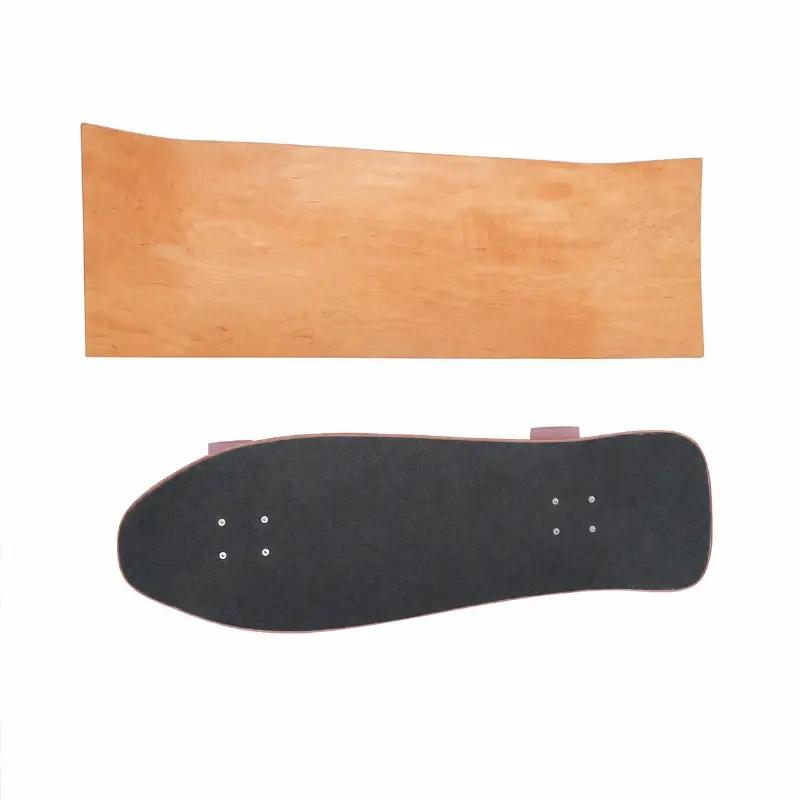
At Vigor Tech, we manufacture skateboard decks with cold-press, laminated construction, and perform in-process quality inspections. OEM and skateboard manufacturers must understand how these factors of construction are measured to appropriately assess deck performance and production quality.
What Determines Canadian Maple Skateboard Deck Strength?
Because the hardwood structure of Canadian maple provides a good combination of strength and stiffness, and has a good elastic response, this wood species lends itself to be used in skateboard deck construction. However, to achieve the desired strength and performance of the finished skateboard deck, multiple factors must be taken into consideration.
Veneer Quality, Ply Arrangement, and Bond Integrity
In a seven-ply deck, veneer thickness, grain orientation, and ply arrangement influence stiffness and load distribution. Moisture variation and inconsistent adhesive curing can also affect long-term bond reliability.
Delamination can result from inadequate adhesive coverage, insufficient curing, unsuitable moisture conditions, or loading that exceeds the bond’s capacity. Consistent bond lines help transfer loads between plies. Truck mounting holes and changes in deck geometry can influence local stress distribution and should be considered when evaluating failure locations.
Our OEM options at Vigor Tech include seven-ply Canadian maple decks. We analyze the construction, dimensions and deck geometry based on individual requirements.
High stiffness alone does not demonstrate impact resistance or fatigue durability. These characteristics should be evaluated separately under defined test conditions.
How Does a Canadian Maple Skateboard Factory Test Deck Performance?
Skateboard decks are subjected to a variety of mechanical tests. These help to illustrate a deck's mechanical response to various modes of loading. Ultimately, no single test can fully corroborate real-world deck durability.
Important Mechanical Tests
| Test Name | Key Parameters | Test Interpretation |
| Static Load Test | Force (N) or Load (F) | Capability to withstand a compressive force |
| Flexural Load Test | Load (N), deflection (mm) | Ability to withstand a bending force and behavior of the resulting fracture |
| Impact Load Test | Energy (J), failure | Ability to withstand an impact load and the extent of the resultant damage |
| Fatigue Load Test | Cycles to Failure (or Stiffness Loss) | Degradation of a structure from repeated loading |
| Bond Test | Bond Failure | Reliability of the adhesive and laminates |
| Dimensional Inspection | Dimensions | Accuracy of thickness, concave, and hole spacing; assembly compatibility |
Factors that Affect Testing Conditions
A Canadian Maple Skateboard Factory should have a tested configuration to allow for more reasonable comparisons when assessing the mechanical behavior of the components. For bending behavior tests:
•Support Span: The further the supports are apart, the greater the deflection.
•Loading Position: The manner in which a load is distributed affects the stresses developed within the specimen.
•Loading Rate: This may affect the behavior of a specimen when it fails.
•Specimen Condition: Moisture, temperature, etc. affect the manner in which a specimen responds to loading.
Bending stiffness of components may be evaluated from their load vs. deflection behavior, which should be within the linear elastic range. However, the load-deflection behavior is dependent upon the tests arrangement, and therefore should not be regarded as an intrinsic property of the material being tested.
Impact testing is used to evaluate failure behavior as a result of a single load. Fatigue testing is used to study failure behavior as a result of repeated loads. Cracks in the deck can occur in regions of bond-line separation near the truck mounting holes even with an acceptable outcome of the static load test.
Failure behavior is determined through destructive testing, while non-destructive testing is used to evaluate geometry and other defects that may not be readily apparent. Both methods serve different purposes.
What Is the Effect of Cold-Press Technology on Deck Quality?
The conditions of pressing influence the quality of laminated maple skateboard decks.
At Vigor Tech, we have employed cold-press technology rather than relying on elevated pressing temperatures. Using cold press technology limits the thermal exposure of maple layers during lamination, and the final bonding strength is dependent on the chemistry of the adhesive, pressure, moisture, and curing time.
| Manufacturing Factors | Cold Pressing | Hot Pressing |
| Processing Temperature | Lower | Elevated |
| Adhesive Curing | Time and adhesive dependent | Temperature and adhesive dependent |
| Critical Controls | Pressure, moisture, curing time | Temperature, pressure, curing time |
| Quality Verification | Bond integrity, flexural response | Bond integrity, flexural response |
A skateboard manufacturer should verify bonding performance rather than assume that one pressing method automatically produces stronger decks.
Poor adhesive coverage, inadequate curing and uneven pressure can also leave weak interfaces. For example, inadequate coverage of adhesive along the interfaces can result in low bonding. When a skateboard is subjected to repeated bending, interlaminar shear stresses can extend these defects into visible delaminations.
Because of this, bond integrity and mechanical performance should be assessed concurrently.
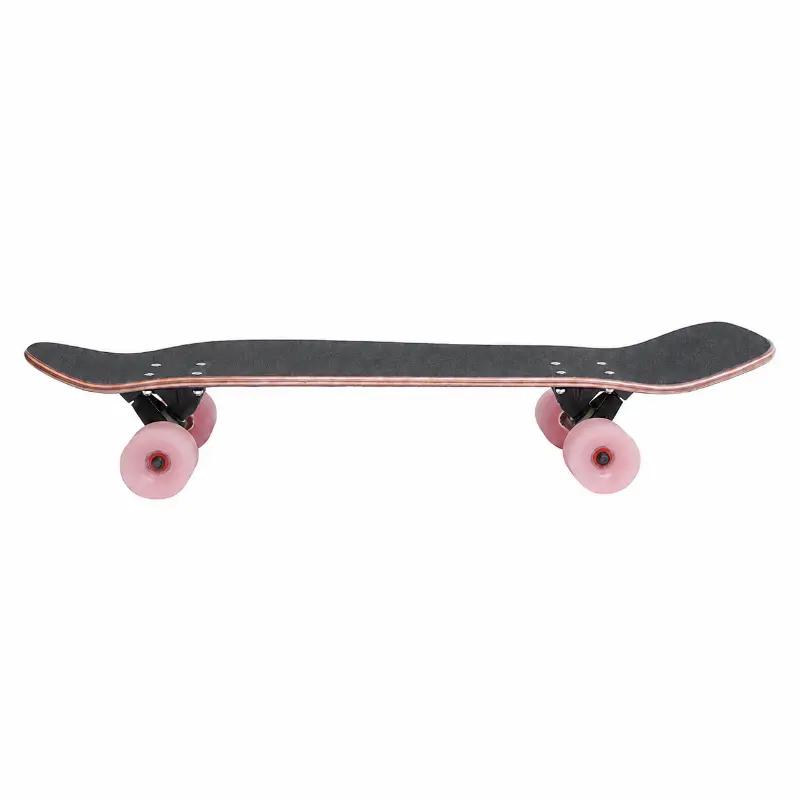
How Do We Achieve Consistent Quality Throughout OEM Manufacturing?
Due to the variances in production, deck geometries, finishes and mechanical responses can vary between samples.
Our process includes design confirmation, approved sample inspection, mass production, quality control inspections and shipment.
Quality-Control Checkpoints
Review of Material and Specifications: Review the construction and dimensions of the decks, the type of concave, the mounting layout, surface finish and other requests.
•Sample Approval: Approve the sample geometry, elasticity, finish and appearance for their intended use.
•Production Supervision: For each step of production (CNC shaping and drilling, sanding and finishing and pressing) check that finishes and process controls are in accordance with the approved sample.
•Review overall deck appearance for request and appearance.
•Final Inspection: Elasticity test, Load test, Durability test and dimensional inspection.
•The same quality-control checkpoints are valid for a Canadian Maple Skateboard Factory.
In addition, the same sampling plans and inspection limits and procedures for the disposal of nonconforming parts must be defined.
A specified accepted sample only serves as a reference specification, not a guarantee that subsequent decks produced will perform the same.
Which Standards and Inspection Records Matter?
OEM buyers should distinguish product safety requirements from material testing and factory management certification.
| Standard | Scope | Verification Purpose |
| EN 13613:2009 | Complete non-motorized skateboards | Applicable product safety requirements |
| ASTM D4442-20(2025) | Wood and veneer moisture measurement | Material moisture verification |
| ISO 9001 | Quality management systems | Process management, not deck strength certification |
EN 13613 will not certify an individual unassembled skateboard deck. Similarly, certification to ISO 9001 will not be a substitute for the mechanical performance test.
Prior to confirming bulk orders, buyers must request inspection documentation to identify the following:
- Sample and production batch identification
- Test method, loading condition and equipment
- Actual test results and acceptance limits
- Inspection date, deviations and corrective actions
- Strength claims, absent test conditions, will limit the value for a technical comparison.
How Should Buyers Select a Canadian Maple Skateboard Factory?
When evaluating Canadian Maple Skateboard Factories it is important to understand how the factory has selected the raw materials, what manufacturing techniques and what inspection processes support the intended use of the skateboard.
•Does the maple skateboard deck construction support the intended riding conditions?
•Can the manufacturer support deck strength and stiffness, and adhesive bonding through testing?
•What are the dimensional tolerances for the deck and what inspections criteria have been established?
•Can the approved requirements for deck dimensions be maintained?
At Vigor Tech we have established and effective production inspections processes, along with other value added services for Canadian Maple Skateboard Deck production.
For OEM and ODM sourcing of Canadian Maple Skateboard Decks, contact us to discuss your deck specifications, what samples are required, your quality requirements and expectations, and any other requirements you have for your next skateboard production.
FAQs
Q1. Does Vigor Tech manufacture Canadian maple skateboard decks?
Yes. We offer Canadian maple skateboard decks, including seven-ply constructions, for OEM and custom skateboard projects.
Q2. What pressing technology does Vigor Tech use?
We use cold-press technology to manufacture laminated maple skateboard decks, with a focus on bonding consistency and deck construction.
Q3. How does Vigor Tech inspect skateboard deck quality?
Our production workflow includes batch load testing, visual inspection, and dimensional verification before shipment.
Q4. Does Vigor Tech test skateboard deck elasticity?
Yes. Our custom skateboard production process includes elasticity checks to assess deck response against applicable product requirements.
Q5. Can Vigor Tech customize skateboard deck thickness and shape?
We support custom deck dimensions, shapes, concave profiles, and material configurations. Specifications are reviewed before sampling and production.


In This Article
- What Determines Canadian Maple Skateboard Deck Strength?
- How Does a Canadian Maple Skateboard Factory Test Deck Performance?
- What Is the Effect of Cold-Press Technology on Deck Quality?
- How Do We Achieve Consistent Quality Throughout OEM Manufacturing?
- Which Standards and Inspection Records Matter?
- How Should Buyers Select a Canadian Maple Skateboard Factory?
Show All
Collapse
Related Posts
OEM Skateboard Manufacturing: Cost Factors Behind Bulk Skateboard Orders
October 29, 2026
How to Find a Skateboard Manufacturer: A Factory Evaluation Guide
October 29, 2026
Skateboard Deck Factory in China: How Pressing Shapes Deck Consistency
October 29, 2026
Custom Blank Skateboard Deck Manufacturer: Canadian Maple vs. Birch vs. Bamboo Decks
October 29, 2026
Start Your Project
-

Custom skateboard solutions from deck design, materials, graphics to complete product development.
-
Professional OEM support covering sampling, production, quality control and bulk delivery.
-
Provide reliable production support for brands, distributors and retailers worldwide.


