





Ply Vs 8 Ply Skateboard Deck: Which is Better?

Related Posts

Canadian Maple for Skateboards: What Makes It So Special?
November 12, 2026

Skateboard Wholesale Supplier: Build a Better Supply Chain
November 12, 2026

Skateboard Manufacturer for Skate Brand | Custom & Wholesale
November 12, 2026

Skateboard Deck Sizes Explained: A Beginner’s Guide
November 12, 2026
7 Ply Vs 8 Ply Skateboard Deck: Which is Right?
When you look at skateboard decks, you may see “7 ply” or “8 ply.” Both are made of thin layers of wood. But they do not feel the same. Each one has its own strengths.
What is a Ply?
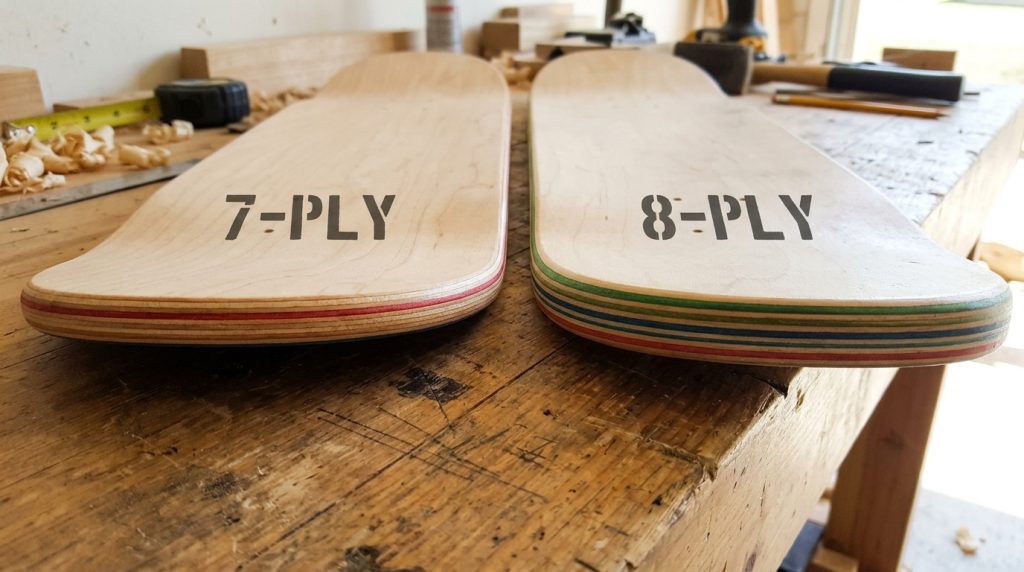
A ply is one layer of wood. Decks are made by gluing thin sheets of wood together. These sheets are called veneers. A 7-ply deck has seven layers. An 8-ply deck has eight layers.
Putting a Regular Seven-Ply to the Test
Basically, we have a regular seven-ply board. We’re going to take these and smash both of them into the corner of the loading dock. We’ll see how it goes.
Here’s what the aftermath looks like on test number one. Actually not that terrible. Let’s try again. We should give it a solid three for each.
That smashes those plies at the top. So here we can peel the grip back a bit. That’s pretty, that’s, that’s a solid chip right there.
Oh my god, dude, look at that. That right there is some chipping business. Go try to kickflip a set of stairs, kick it out. That’s what happens on a normal seven.
On a regular seven-ply, there are these cross plies, and what they do is they’re sort of laid out like this. And because when it smashes in, what it does is it makes it so they kind of, they sort of break up, if that makes any sense.
Weight
An extra layer adds extra wood. So an 8-ply deck is usually heavier than a 7-ply deck of the same size.
For how big this board is, for it being 32 in long and 8.4 in wide, it’s fairly lightweight. For how wide it is, it didn’t feel super heavy. This might not matter to most people, but I’m always trying to lighten up my setup.
Size and Wheelbase
It’s a little bit longer than I normally skate. I honestly like things like the 31 range. Also, it is a 14 and a quarter wheelbase. This is actually a little bit longer than I normally skate. I personally prefer the 1380, the smaller wheelbase. It just is a little bit more poppy, just turns a little bit easier; it’s just overall more responsive. Obviously, with a longer wheelbase, it definitely feels a lot more stable. At the same time, it’s crazy how much slower I feel the board turn with this longer wheelbase than my shorter wheelbase.
Also, the nose and tail are twins. I actually prefer this nose length. It’s actually a really nice size. With the wheelbase, with the nose and tail kind of being on the longer mellow side, I felt like manuals were just really easy on this board.
Tail Shape and Pop
When I am popping off of my tail, I prefer not to have a square tail. And the reason why is just that it’s harder to scoop. Square things just don’t scoop as easily. Obviously, if it’s a little rounded corner, it’s going to scoop a little bit easier. But the positive thing about having a squared-off tail is you’re going to pop straight. When you have a square tail, you’re going to pop straight up. You’re not going to really pop off to the side.
And that’s really good when you’re doing ollies, shove-its, I mean even just kickflips, heelflips, all your normal flip tricks with a square tail usually go straight, and they pop really nice. First, when I was looking at this, I really wasn’t sure what kind of tail scoop and pop I was going to get, but it did really surprise me that it worked really well.
Trucks and Bushings
You could probably even fit a 159 if you want your trucks to stick out a little bit more. And the reason why you’d want to do that is just a little bit more stability. It’ll just be a little bit easier to lock into feeble grinds, crooked grinds, essentially cuz there’s just more truck. As I mentioned before, the wider truck can just help you with certain grind tricks. So I kind of prefer the wider truck.
I do prefer the harder bushing. So what I really like about the hard bushing is the rebound. And when I say rebound, I’m talking about when your board is turning, and it snaps back to the middle. Obviously, if you have a softer bushing, it’s going to do that much slower. And now you’re going to ask, why is this important?
It’s kind of important because when you’re popping your board to straight popping, sometimes you start turning, and that little unlevel pop can mess up your trick. With the harder bushing, it just kind of gives you a more stable pop. Feel like you’re just more consistently popping straight up versus off to the side by mistake. And in my opinion, I think another positive thing about the hard bushing is that when you’re doing like a crooked grind or a feeble grind, it’s just a little bit easier to pop out of the trick.
Wheels
The 101 duro is a little bit harder and slides a little bit more. I feel it’s a little bit more consistent when it slides. I kind of like the way it sounds too on the ground. These wheels are really good for locking into ledges. Since the ledge is squared off and the wheel is squared off, it just locks in really well. The other reason why I like this wheel is because it’s pretty lightweight sort to say. Since it is so narrow, usually wheels are a little bit wider, and it is a little bit heavier. Since it doesn’t have all that extra wheel, it’s a little bit lighter.
As far as the sliding goes, it’s really comfortable to hold a nose slide or tail slide on this board. So obviously, with the squared-off nose and tail, you have a lot more surface to slide on.
Strength and Chipping
Another thing I didn’t really think about was obviously, once I started street skating with this board, I do feel like these edges will get kind of torn out pretty quickly. Not that these are messed up already, but even from the few bails I did in street skating, I can kind of tell that the corners of this board, they’re not endangered, but I can kind of see them probably chipping up. Not easy, but chipping more than a rounded nose, you know what I mean? So, when this board does run into, like, a sharp edge or something, something might happen.
But a well-made 7-ply deck is also very strong; how the deck is built matters a lot. In short, do not judge a deck by ply count alone. Ask how it is made.
Why We Build on 7-Ply Maple
Vigor Tech uses 7-ply maple for all of our decks. It gives the best mix of strength, weight, and pop for the boards we make. Our 29” × 7.25” deck is 10.5 mm thick. Request a quote and tell us what you need.


In This Article
Related Posts
Canadian Maple for Skateboards: What Makes It So Special?
November 12, 2026
Skateboard Wholesale Supplier: Build a Better Supply Chain
November 12, 2026
Skateboard Manufacturer for Skate Brand | Custom & Wholesale
November 12, 2026
Skateboard Deck Sizes Explained: A Beginner’s Guide
November 12, 2026
Start Your Project
-

Custom skateboard solutions from deck design, materials, graphics to complete product development.
-
Professional OEM support covering sampling, production, quality control and bulk delivery.
-
Provide reliable production support for brands, distributors and retailers worldwide.


