





OEM Skateboard Printing: Heat Transfer vs. Direct Screen Printing
Related Posts
How to Buy Skateboard Decks in Bulk: A Practical Guide for Brands, Retailers
September 24, 2026
Responsible Material and Process Choices for Skateboard Deck Manufacturing
September 24, 2026
How to Evaluate a Skateboard Manufacturer in China
September 24, 2026
Private Label Skateboard Deck Manufacturing for Independent Skate Shops
September 23, 2026
Appearance of a graphic can look different when printed on a curved, coated wooden deck. The print can be altered by background opacity, surface preparation, registration, and finishing.
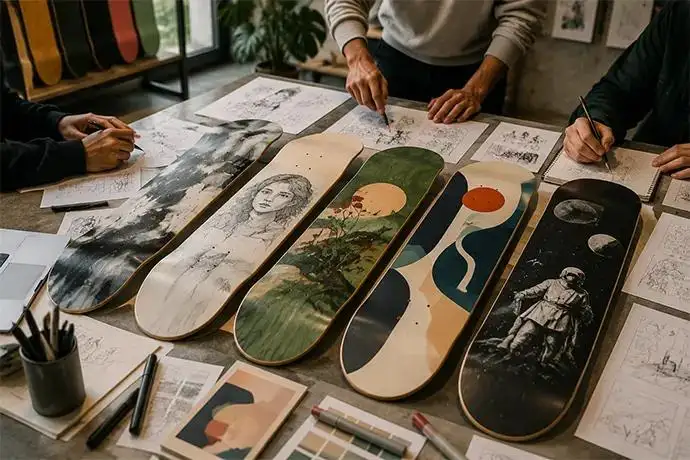
When printing a deck at Vigor Tech, we consider deck dimensions, concave profile, artwork placement, and approved samples as part of the production process. We develop eye-catching graphics that remain consistent and repeatable across production runs.
Heat transfer moves a preprinted graphic from a carrier onto the deck. Direct screen printing deposits ink directly onto the deck through a stencil. Choosing between them requires comparing the complete production routes.
Understand the Two OEM Skateboard Printing Processes
Heat Transfer: Carrier Preparation and Application
Heat transfer has two stages: producing the graphic on a carrier and transferring it onto the prepared deck using heat and pressure.
The carrier graphic may be screen-printed or digitally printed. Consequently, heat transfer versus direct screen printing is not the same comparison as digital versus screen printing.
Key process variables are surface condition, exposure to heat, contact pressure, and release conditions. The approved combination of carrier and deck coating used with defined process settings is more important than a temperature suggestion.
Direct Screen Printing: Ink Deposition and Registration
In direct screen printing, ink is transferred onto the deck surface through a stencil-based process. For multi-color graphics, each color may require separate screen preparation and printing steps, with alignment (registration) and ink curing or drying controlled according to the specific production process and equipment used. The exact workflow depends on the factory’s available printing systems, materials, and quality control procedures.
The process variables of screen mesh, stencil thickness, ink, viscosity, and the squeegee are all important in achieving the desired ink deposit. The degree of curvature of the deck introduces another variable on the process; the screen must contact the desired printing position without unacceptable distortion or loss of detail.
Fine detail and halftones may be printed, but fine details should be verified as production-representative samples.
OEM Skateboard Printing Comparison for Buyers
| Decision Factor | Heat Transfer | Direct Screen Printing |
| Graphic Reproduction | Depends on whether the carrier is digitally or screen-printed. | Depends on color separation, screen preparation, and ink control. |
| Brand Colors | Requires evaluation of transfer color, opacity, and background. | Requires ink matching, controlled deposit, and registration. |
| Curved Coverage | Transfer contact must remain consistent across concave and raised ends. | Screen contact and fixtures determine the practical printable area. |
| Setup Cost | Includes carrier production and application preparation. | Includes screens, registration, and color-change preparation. |
| Quantity Economics | Depends on carrier process and quantity per design. | Depends on color count, setup allocation, and printing operations. |
| Surface Appearance | Influenced by the transfer system and finishing sequence. | Influenced by ink thickness, texture, and finishing sequence. |
| Durability | Verify adhesion and abrasion on the finished construction. | Apply the same finished-product verification principle. |
Neither process is automatically cheaper or more durable. Compare quotations against identical artwork, deck construction, finish, and inspection requirements.
Design the Graphic Around the Actual Deck
Control Background Color and Opacity
Natural maple, stained veneer, and painted backgrounds can produce different results beneath the same graphic. Where inks are not fully opaque, the substrate contributes to the visible color.
For color-critical OEM Skateboard Printing, specify:
• Whether wood grain should remain visible.
• Whether opaque coverage or a white underbase is required.
• Brand-color references and agreed viewing conditions.
• Matte or gloss finish.
• A physical sample as the production appearance reference.
Pantone references communicate color intent; they do not eliminate substrate and finish effects. If instrumental color tolerances are required, agree on the measurement method before approval.
Match Templates to Shape and Concave
Use the actual deck outline and dimensions when preparing artwork. Keep essential lettering and logos inside an agreed safe area; extend background artwork into the required bleed.
Review alignment relative to the deck centerline and mounting holes. A graphic approved for one width should be checked again before use on another shape.
Our Vigor Tech OEM service connects deck size, shape, concave, graphic placement, and surface-finish discussions, helping resolve these relationships before sampling.
Calculate Cost Per Design, Not Just Per Order
An OEM Skateboard Printing quotation should separate one-time preparation from recurring production costs.
Confirm:
• Number of colors and artwork variations, including rules for mixed-design orders.
• Preparation for screen or transfer.
• Color count, underbase, and finishing charges.
• Cost and timing for revised samples and approvals.
• Requirements for repeat orders of the same product and packaging.
One thousand decks across ten designs can have different economics from one thousand decks carrying one design. Lead time should also include artwork correction, material preparation, sample review, and production scheduling.
Verify Print Quality Before Bulk Approval
| Checkpoint | What to Confirm |
| Artwork Review | Correct revision, final-size resolution, outlined fonts where required, bleed, and orientation. |
| Physical Sample | Color, coverage, registration, graphic placement, and surface appearance. |
| Adhesion and Wear | Agreed test procedure, conditioning, and acceptance criteria appropriate to the finish. |
| Batch Inspection | Consistency against the approved sample and agreed defect limits. |
| Packaging Review | Protection against rubbing and surface damage during handling and shipment. |
Normal riding abrasion from regular board use should be distinguished from premature peeling, coating separation, or printing adhesion failures. Adhesion tests and rubbing tests are useful for evaluating specific surface performance under defined conditions, but they do not independently predict the overall service life of a skateboard deck. Actual durability depends on multiple factors, including riding conditions, impact frequency, deck construction, environmental exposure, and usage patterns.
Vigor Tech verifies sample orders, carries out graphic alignment tests, checks for appearance and packaging, and coordinates all approved production designs.
Planning Graphic Design with Vigor Tech
Send Vigor Tech the required project details, including artwork files, deck size, quantity per design, finish requirements, and target delivery date. We can review OEM skateboard printing options, graphic production requirements, and sample needs to establish a clear specification for a mass production order or bulk order.
FAQs
Q1. Does Vigor Tech Offer OEM Skateboard Printing With Custom Artwork?
Yes. Vigor Tech accepts customer artwork and logo files for OEM skateboard projects. Provide your deck dimensions, graphic placement, color references, and finish requirements so we can review the design before sampling.
Q2. What Skateboard Printing Methods Can I Discuss With Vigor Tech?
Our OEM service includes planning for heat transfer and screen printing. We review the artwork, deck shape, coverage requirements, and order quantity to discuss a suitable production approach. Confirm the specific printing route during quotation and sampling.
Q3. What Files Should I Send to Vigor Tech for Printing Review?
Send your original artwork, logo files, intended print dimensions, and deck specifications. Include color references and placement instructions. Before final submission, confirm file-format, resolution, bleed, and font requirements with our team.
Q4. Can Vigor Tech Help Match My Brand Colors?
Color matching can be discussed during OEM project planning. Supply your brand-color references and specify whether the graphic will appear over natural wood, stain, or an opaque background. Use a physical sample to confirm the agreed appearance before production.
Q5. Can Vigor Tech Adapt Graphics to Different Deck Shapes?
We can review graphic placement alongside deck size, shape, and concave. Each deck format should have its own artwork-position check, particularly around the nose, tail, mounting holes, and edges, where resizing can affect alignment or crop important details.


In This Article
Related Posts
How to Buy Skateboard Decks in Bulk: A Practical Guide for Brands, Retailers
September 24, 2026
Responsible Material and Process Choices for Skateboard Deck Manufacturing
September 24, 2026
How to Evaluate a Skateboard Manufacturer in China
September 24, 2026
Private Label Skateboard Deck Manufacturing for Independent Skate Shops
September 23, 2026
Start Your Project
-

Custom skateboard solutions from deck design, materials, graphics to complete product development.
-
Professional OEM support covering sampling, production, quality control and bulk delivery.
-
Provide reliable production support for brands, distributors and retailers worldwide.


