





OEM Skateboard Deck Factory: Testing Pop, Stiffness, and Durability
Related Posts
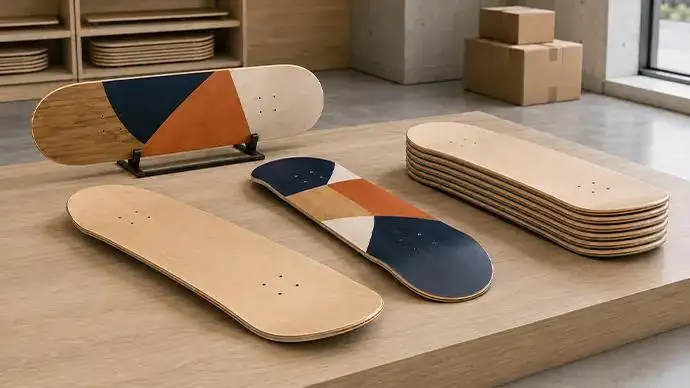
How to Buy Skateboard Decks in Bulk: A Practical Guide for Brands, Retailers
September 24, 2026

Responsible Material and Process Choices for Skateboard Deck Manufacturing
September 24, 2026
How to Evaluate a Skateboard Manufacturer in China
September 24, 2026
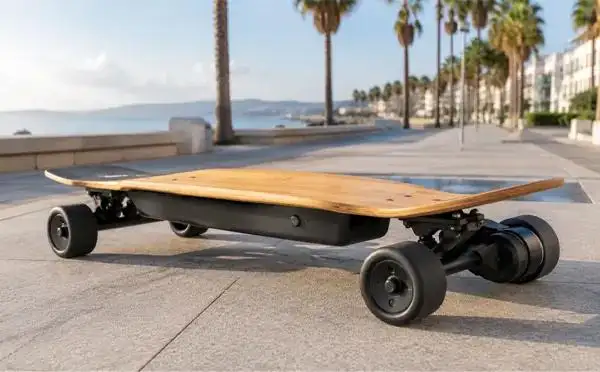
Private Label Skateboard Deck Manufacturing for Independent Skate Shops
September 23, 2026
A deck that feels lively during sampling may soften after repeated sessions. A stiff deck may still suffer impact damage or premature delamination. For brands evaluating an OEM Skateboard Deck Factory, these are separate performance questions that require different evidence.
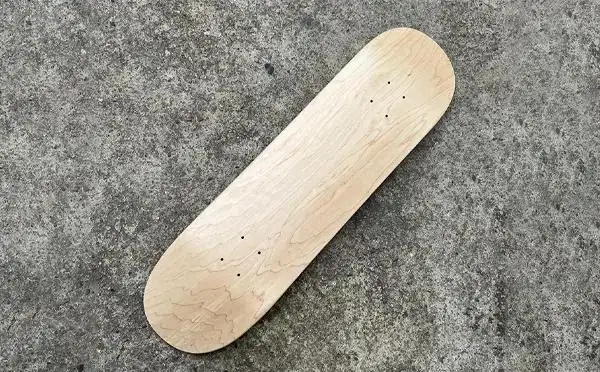
At Vigor Tech, our OEM service connects deck construction, geometry, component selection, sample confirmation, and production inspection. Performance evaluation should begin with a defined riding application and an agreed specification—not an unsupported promise of "better pop."
Separate Pop, Stiffness, and Durability
An OEM Skateboard Deck Factory should evaluate these characteristics independently before considering their interaction.
| Property | Engineering Focus | Useful Evidence | Interpretation Limit |
| Pop | Dynamic takeoff response involving tail contact, geometry, and rider input | Controlled motion measurements and repeatable riding feedback | Sound or fixture rebound alone cannot predict ollie height |
| Stiffness | Resistance to deformation under load | Load–deflection slope and residual deformation | High stiffness does not establish impact resistance |
| Durability | Retention of performance through loading, wear, and environmental exposure | Stiffness retention, cracking, delamination, and profile wear | A single breaking-load result cannot establish service life |
Strength is another distinct measure: the load or stress associated with failure under a specified test. Buyers should avoid treating strength, stiffness, and durability as interchangeable specifications.
Define the Comparison Before Testing
Control Geometry and Sample Condition
An ideal OEM skateboard deck factory comparison includes a sample record including:
•Dimensions: Width, thickness, wheelbase, concave, and nose/tail geometry.
•Construction: Veneer species, thickness distribution, grain orientation and adhesive system.
•Conditioning: Temperature, relative humidity, conditioning duration, and measured moisture condition.
•Traceability: Includes Sample ID, manufacturing batch, and observable defects.
How to measure wheelbase and concave? Measurement variations include hole and axle spacing, and concave depth can vary with what dimension is selected.
Separate Construction Trials From Product Comparisons
To study different layups, keep geometry and test conditions unchanged. Designs are compared by keeping their intended geometry, but assigning the result to the complete design.
Keep trucks, wheels, grip, and hardware settings the same for the riding trials.
Test Pop Through Dynamic Response and Riding Trials
Controlled Dynamic Evaluation
Dynamic impact evaluation may be conducted by qualified testing facilities equipped with specialized fixtures and high-speed imaging systems. Under controlled conditions, such equipment can apply a defined input while maintaining consistent contact with the deck, allowing analysis of factors such as tail contact behavior, deck rotation, and post-impact movement. .
Record:
•Input methods and input values.
•Constraints on contact surface and fixtures.
•Mass distribution of the deck and the arrangement of components.
•Number of repeated trials and samples
This value should be identified as a fixture-specific response metric measured under defined test conditions. It should not be interpreted as a general pop rating, a universal performance classification, or a representative result for an entire production batch.
Structured Rider Feedback
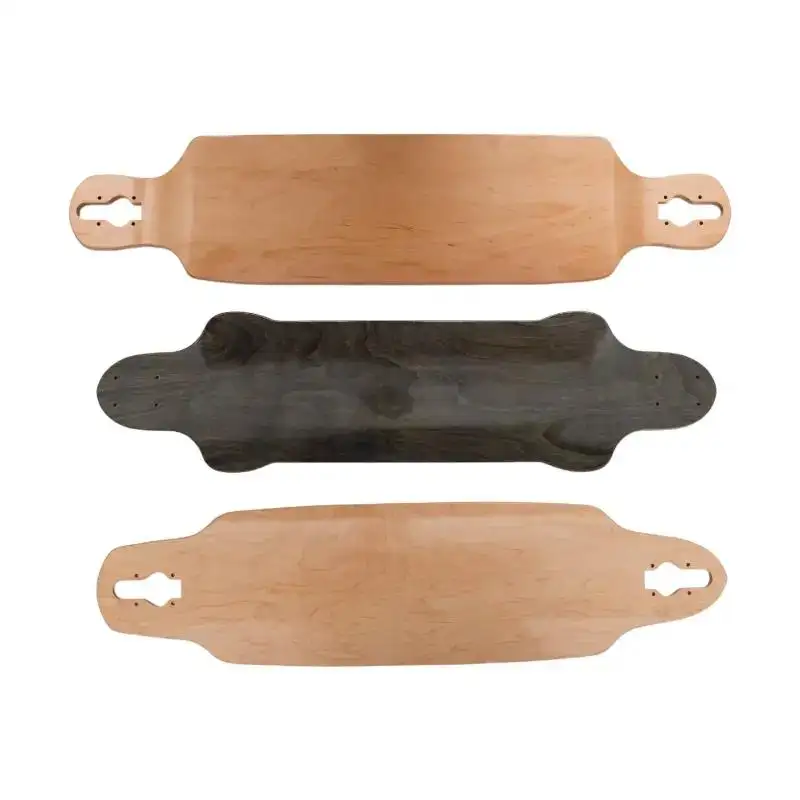
Use randomized sample order and, where practical, conceal construction details. Ask riders to assess takeoff timing, responsiveness, and consistency using the same scoring definitions.
Compare new samples with samples after defined use. If rider feedback conflicts with fixture results, investigate tail geometry, component setup, and input differences before changing the layup.
Measure Stiffness Within a Defined Load Range
An OEM Skateboard Deck Factory stiffness comparison should specify support span, support contact geometry, loading position, and loading rate.
Within the approximately linear load–deflection region:
Effective stiffness, k = ΔF / Δδ
With force in newtons and deflection in millimetres, stiffness is expressed in N/mm. This is a structural result for that setup, not the veneer's elastic modulus.
A useful procedure should involve:
- Placing a small load to make contact.
- Measuring deflection over a defined, non-destructive range.
- Unloading and examining the residual deformation.
- Repeat the test across multiple decks and report individual results, averages and observed variation.
Measurement of deck deflection is the most reliable. A fixture may be compliant during machine movement, which can affect deflection.
More stiffness is not always better. Mass and ride feel could be adversely impacted by changes in thickness or layup, concave etc.
Evaluate Durability by Failure Mode
Durability testing should reveal both damage and performance loss.
| Test Direction | Controlled Variables | Reported Outcome | Engineering Decision |
| Cyclic bending | Load range, frequency, supports | Stiffness retention, permanent set, cycles to defined damage | Review fatigue response |
| Impact | Energy, striker geometry, location | Cracks, indentation, delamination | Investigate localized vulnerability |
| Tail abrasion | Surface, force, travel | Material loss and profile change | Assess functional wear |
| Moisture exposure | Humidity or wetting cycle, duration | Warping, mass change, bond separation | Review environmental stability |
Stiffness retention (%) = stiffness after exposure ÷ initial stiffness × 100
Maintain the same measurement conditions before and after exposure and report individual failures.
Separate sample groups help avoid one destructive test from affecting the other. Accelerated results should not be substituted for months of riding without field validated results.
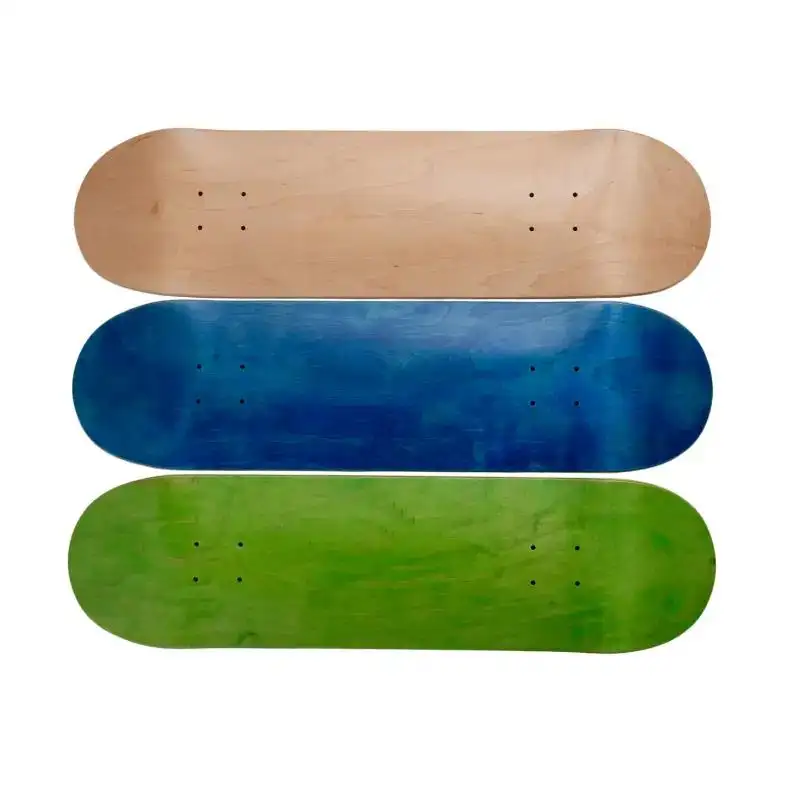
Translate Results into Manufacturable Specifications
For an OEM Skateboard Deck Factory, test results should be the basis for limited design changes.
•Excessive flex: Examine the combination of veneers, the thickness of each, and the concave. Check weight.
•Rapid response loss: Examine fatigue, moisture, bonding, and wear on the tail.
•Delamination: Examine if failure occurs in the wood or at the bond interface.
•Inconsistent riding feedback: Examine the variation in dimensions of the deck.
Vigor Tech supports discussions related to construction of skateboard decks, maple plies, layer structures, deck dimensions, concave, and matching components. Confirmation of samples helps tie the decisions and the product together. For each project, specific test equipment, protocols and formats should be agreed to.
Carry Sample Requirements Into Production
An OEM Skateboard Deck Factory evaluation should continue after the approval of one deck. Buyers should establish:
•Approved specifications and reference samples.
•Batch sampling and identification requirements.
•Agreed test methods and acceptance criteria before the start of any testing.
•Failure and material/process changes scenarios and procedures.
Our sample and production inspection support provides a basis for that discussion. Share your riding application, deck specifications, and evaluation priorities with Vigor Tech to develop a clearer path from prototype assessment to repeatable OEM production.
FAQs
Q1. Can Vigor Tech manufacture custom skateboard decks for our brand?
Yes. Vigor Tech supports OEM projects based on customer requirements, including deck construction, dimensions, shape, concave, graphics, and packaging. Buyers should provide their intended riding application and product specifications before sampling.
Q2. Which deck specifications can we customize with Vigor Tech?
You can discuss deck width, length, wheelbase, shape, concave profile, maple construction, layer structure, and edge finish. The available combination should be confirmed against your design and production requirements.
Q3. Can Vigor Tech help us choose a deck construction?
Vigor Tech can discuss maple construction and layer options based on product purpose. Share your target riding style, preferred weight, desired stiffness, and price level so the proposed specification reflects your priorities.
Q4. Does Vigor Tech provide samples before bulk production?
Yes. Samples can support confirmation of deck structure, graphics, component selection, riding feel, and packaging. Define the evaluation criteria before sampling so approval provides a clear reference for production.
Q5. Can Vigor Tech provide pop, stiffness, and durability test reports?
Specialized tests, including pop response, fatigue testing, and high-speed imaging, are available only after project confirmation. These tests may require specific fixtures, test procedures, or qualified third-party facilities and are not considered standard factory reports.
Standard quality documentation can cover production specifications, dimensions, materials, construction consistency, and finish inspection. Any fixture-specific test result should be treated as a test-condition measurement only and should not be interpreted as a general pop rating, universal performance classification, or a result representing an entire production batch


In This Article
Related Posts
How to Buy Skateboard Decks in Bulk: A Practical Guide for Brands, Retailers
September 24, 2026
Responsible Material and Process Choices for Skateboard Deck Manufacturing
September 24, 2026
How to Evaluate a Skateboard Manufacturer in China
September 24, 2026
Private Label Skateboard Deck Manufacturing for Independent Skate Shops
September 23, 2026
Start Your Project
-

Custom skateboard solutions from deck design, materials, graphics to complete product development.
-
Professional OEM support covering sampling, production, quality control and bulk delivery.
-
Provide reliable production support for brands, distributors and retailers worldwide.


